What Is a Cryptocurrency Mining Program (and How Does It Work)?
A cryptocurrency mining program is specialized software that enables computers to validate blockchain transactions and earn digital currency rewards by solving complex cryptographic puzzles. These programs connect individual miners or mining operations to blockchain networks, coordinating the computational work required to maintain decentralized ledgers and secure cryptocurrency ecosystems.
The global mining industry has matured considerably since Bitcoin’s early days, with mining programs evolving from simple CPU-based applications into sophisticated platforms managing GPU arrays, ASIC hardware, and distributed mining pools. For professionals evaluating mining participation in 2026, understanding how these programs function represents a critical first step in assessing potential returns and operational requirements.
Mining software choices now determine far more than basic functionality. Leading enterprise mining operations report that program selection influences hash rate optimization by 15-20%, directly affecting revenue per kilowatt-hour consumed. The differentiation between consumer-grade mining tools and enterprise solutions has widened, with professional-grade programs offering advanced features like automated pool switching, thermal management integration, and real-time profitability analytics.
This article examines the core mechanics of cryptocurrency mining programs, categorizes the primary types available to professionals, and provides practical frameworks for matching software capabilities to specific mining objectives. Whether optimizing existing operations or conducting initial feasibility assessments, decision-makers require clear insights into how these programs translate computational investment into cryptocurrency returns.
Understanding Cryptocurrency Mining Programs
Cryptocurrency mining programs are specialized software applications that serve as the operational interface between mining hardware and blockchain networks. While the physical equipment, ASICs, GPUs, or CPUs, provides the computational power, the mining program orchestrates how that power is deployed, directing it toward solving cryptographic puzzles that validate transactions and secure the blockchain.
The software layer performs several critical functions that hardware alone cannot accomplish. Mining programs establish and maintain connections to blockchain nodes, retrieve pending transactions that need validation, and format the computational work into tasks the hardware can process. When your mining rig successfully solves a cryptographic puzzle, the program broadcasts that solution to the network and manages the receipt of mining rewards to your designated wallet address.
Understanding the distinction between hardware and software is fundamental. Mining hardware determines your computational capacity, how many calculations you can perform per second. The mining program, however, determines how effectively that capacity is utilized. A poorly configured or outdated mining client can leave significant performance on the table, even with top-tier hardware. Conversely, an optimized program can extract maximum efficiency from modest equipment.
- Hash Rate
- The speed at which mining hardware performs cryptographic calculations, measured in hashes per second (H/s). Higher hash rates increase the probability of successfully mining a block and earning rewards.
- Mining Pool
- A collaborative arrangement where multiple miners combine their computational resources to increase their collective chances of solving blocks. Rewards are distributed proportionally based on each participant’s contributed hash power.
- Proof-of-Work
- The consensus mechanism requiring miners to solve computationally intensive puzzles to validate transactions and add new blocks to the blockchain. This process secures the network by making attacks prohibitively expensive.
- Mining Client
- The specific software application installed on a mining system that connects to the blockchain network or mining pool. Different clients support different algorithms, cryptocurrencies, and hardware configurations.
Mining programs also handle critical operational tasks beyond basic computation. They monitor hardware temperatures and performance metrics, implement overclocking or undervolting strategies to optimize efficiency, and switch between different mining algorithms or cryptocurrencies based on profitability calculations. Advanced programs incorporate failover mechanisms that automatically redirect mining efforts if a pool becomes unavailable, ensuring minimal downtime and protecting revenue streams.
How Cryptocurrency Mining Programs Work

The Mining Process: Step-by-Step
Mining programs orchestrate a precise sequence of operations that transform computational power into verified blockchain transactions. Understanding this step-by-step process reveals how software bridges the gap between raw hardware capability and meaningful network contribution.
Step 1: Retrieving Unconfirmed Transactions
The mining program connects to the blockchain network and retrieves pending transactions from the mempool, a temporary holding area for unverified transactions. The software evaluates these transactions based on fee priority and validity, selecting which ones to include in the next potential block.
Step 2: Constructing the Block Structure
Once transactions are selected, the program organizes them into a candidate block. This involves creating a block header containing critical metadata: a reference to the previous block (maintaining the chain), a timestamp, the Merkle root (a cryptographic fingerprint of all included transactions), and an empty nonce field that will be manipulated during the mining attempt.
Step 3: Solving the Cryptographic Puzzle
The program begins rapidly generating and testing different nonce values, feeding each variation through the hashing algorithm specified by the blockchain protocol (SHA-256 for Bitcoin, for example). Each attempt produces a unique hash output. The software compares this hash against the current difficulty target, a threshold value that determines mining difficulty.
Step 4: Block Validation and Broadcast
When the program discovers a hash meeting the difficulty requirements, it immediately broadcasts the completed block to the network. Other nodes verify the solution’s validity. If accepted through network consensus, the block joins the permanent blockchain, and the mining program receives the block reward plus transaction fees, which it routes to the configured wallet address.
Communication with Mining Hardware and Pools
Mining programs serve as the critical software bridge between computational hardware and blockchain networks, translating abstract mining algorithms into executable instructions for physical devices. When a program initializes, it first detects connected hardware, whether ASICs, GPUs, or CPUs, through device drivers and APIs specific to each manufacturer. The software then configures optimal parameters for each device, including clock speeds, power consumption targets, and memory allocation, based on the cryptocurrency being mined and the hardware’s capabilities.
For pool-based mining, the program establishes a persistent connection to the pool’s server using protocols like Stratum or GetWork. This connection enables bidirectional communication: the pool sends work assignments (block templates with specific parameters), and the mining program distributes these tasks across available hardware units. As devices process hashing attempts, the software continuously monitors their output, collecting valid shares, partial solutions that prove computational work, and submitting them to the pool for verification.
The program manages this coordination through multi-threaded operations, ensuring each GPU core or ASIC chip receives fresh work immediately upon completing previous assignments. It tracks hardware performance metrics in real-time, including hash rates, temperature readings, and error rates, adjusting workload distribution to prevent overheating or hardware failures. When a device finds a valid share or, rarely, a complete block solution, the program packages the proof-of-work data and transmits it to the pool within milliseconds, maintaining the time-sensitive nature of mining rewards.
Types of Cryptocurrency Mining Programs
Solo Mining Software
Solo mining software enables miners to validate transactions and create blocks independently, without joining collaborative mining pools. These programs connect directly to a blockchain network’s full node, allowing miners to attempt block discovery using only their own computational resources. When successful, solo miners receive the entire block reward rather than sharing it with pool participants.
The primary advantage of solo mining lies in maximum profit potential, miners keep 100% of rewards without paying pool fees or splitting earnings. Solo software also provides complete operational independence, eliminating reliance on pool infrastructure and avoiding potential pool-related downtime or disputes.
However, solo mining presents significant limitations in 2026’s competitive landscape. The probability of successfully mining a block depends entirely on a miner’s hash rate compared to the total network hash power. For major cryptocurrencies like Bitcoin, where network difficulty has reached unprecedented levels, even substantial mining operations may wait months or years between successful blocks, creating unpredictable and often unsustainable cash flow.
Solo mining software is most viable for miners with substantial hash power, those targeting newer cryptocurrencies with lower network difficulty, or enthusiasts prioritizing decentralization principles over consistent profitability. Popular solo mining programs include Bitcoin Core’s built-in mining functionality and specialized clients like CGMiner configured for direct node connection.
Pool Mining Clients
Pool mining clients represent the most widely adopted mining software category, designed to connect individual miners with collaborative mining pools where computational resources are aggregated to increase the probability of successfully mining blocks. These programs handle the technical complexity of pool participation, including authentication, work distribution, share submission, and reward tracking.
The software establishes a persistent connection to pool servers using protocols like Stratum, which efficiently distributes mining tasks to connected clients and collects proof-of-work submissions. When a miner’s hardware finds a valid solution, the pool client immediately transmits this share to the pool server, which verifies and credits the contribution. Most pool clients support multiple pools simultaneously, allowing automatic failover if the primary pool experiences downtime or network issues.
Popular pool mining clients like CGMiner, BFGMiner, and Awesome Miner offer customizable parameters for hash rate optimization, temperature monitoring, and profit switching between different cryptocurrencies. Mid-scale operators particularly value pool clients with detailed statistics dashboards that display real-time performance metrics, rejected shares, and estimated earnings. The software typically requires minimal configuration beyond entering pool URL credentials and wallet addresses, making pool participation accessible even to miners with limited technical expertise.
Cloud Mining Platforms
Cloud mining platforms represent a distinctly different approach to mining software, shifting computational resources entirely to remote data centers. These web-based or application-based programs allow users to purchase or lease hashing power without owning physical mining equipment, eliminating hardware procurement, maintenance, and electricity costs from the individual’s responsibilities.
The software interface typically provides a dashboard where users select mining contracts specifying cryptocurrency type, hash rate allocation, and contract duration. Behind this simplified front-end, the platform operator manages vast mining facilities with thousands of ASIC miners or GPU rigs. Users receive proportional mining rewards based on their contracted hash power, minus service fees and operational costs deducted by the provider.
While cloud mining removes technical barriers and capital investment requirements, it introduces counterparty risk. Users depend entirely on the platform’s operational integrity, with numerous historical instances of fraudulent schemes disguised as legitimate cloud mining services. Reputable platforms demonstrate transparency through facility documentation, regular payout histories, and verifiable blockchain activity. The economic viability often proves marginal compared to direct hardware ownership, as platforms naturally price contracts to ensure their own profitability margins, leaving users with reduced returns after all fees are factored.
Enterprise Mining Management Systems
Large-scale mining operations running hundreds or thousands of devices require centralized control infrastructure that individual mining clients cannot provide. Enterprise mining management systems function as comprehensive software platforms purpose-built for industrial operations, integrating fleet monitoring, remote configuration, performance analytics, and automated optimization across distributed facilities.
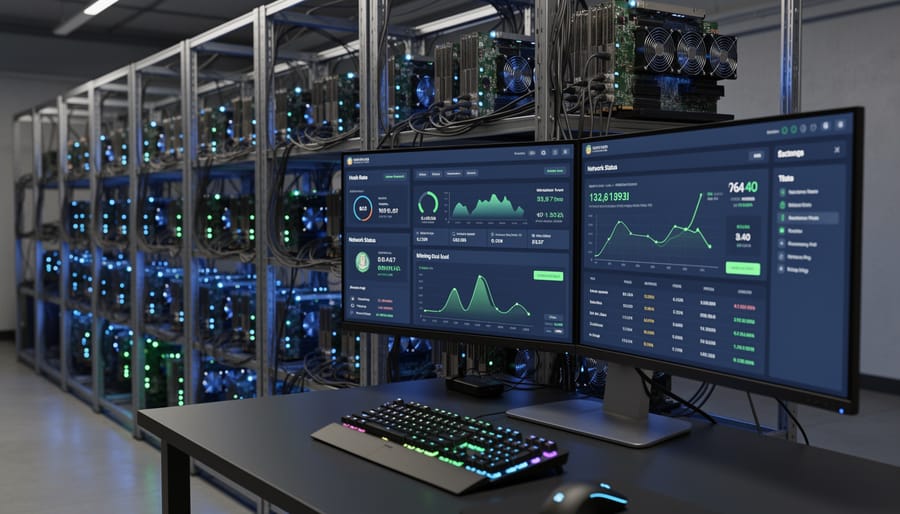
These systems typically feature real-time dashboards displaying hashrate, power consumption, temperature metrics, and error rates for every connected device. Administrators can remotely adjust mining parameters, switch between coins or pools, and execute firmware updates across entire device fleets without physical access. Advanced platforms incorporate machine learning algorithms that automatically tune overclocking profiles based on thermal conditions and electricity pricing, maximizing profitability while preventing hardware degradation.
Leading enterprise solutions like Hive OS, Awesome Miner, and Foreman provide API integrations with pool operators and electricity providers, enabling automated decision-making based on market conditions. Some platforms include predictive maintenance modules that flag devices showing performance degradation patterns before catastrophic failures occur, reducing downtime costs. For operations spanning multiple geographic locations, these systems aggregate data across sites, providing unified operational visibility that would be impossible with standalone mining software.
Key Features and Capabilities of Modern Mining Programs
Modern cryptocurrency mining programs in 2026 have evolved far beyond simple computational coordinators. Today’s software solutions integrate sophisticated capabilities that directly impact profitability, operational efficiency, and security across mining operations of all scales.
At the foundation, multi-algorithm support has become table stakes rather than a premium feature. Contemporary mining programs seamlessly switch between SHA-256, Ethash variants, Equihash, and emerging consensus algorithms without manual reconfiguration. This flexibility allows miners to respond to market conditions and network difficulty changes in real-time, maximizing hardware utilization regardless of which blockchain offers the best returns at any given moment.
Real-time monitoring and analytics dashboards represent perhaps the most visible advancement in mining software. These interfaces provide granular visibility into hash rates, temperature readings, power consumption, and earnings projections across entire mining fleets. The best programs correlate this data with external factors like electricity costs and cryptocurrency prices, generating actionable insights rather than raw numbers. For operations running hundreds or thousands of devices, centralized visibility transforms management from reactive troubleshooting to proactive optimization.
Critical features that separate professional-grade mining programs from basic solutions include:
- Multi-algorithm support with automatic profitability-based switching between coins and networks
- Comprehensive monitoring dashboards tracking hash rate, temperature, power draw, and earnings in real-time
- Dynamic power optimization adjusting voltage and clock speeds based on efficiency targets
- Intelligent pool failover ensuring continuous operation if primary mining pools experience downtime
- Hardware health monitoring with predictive alerts for component degradation or failure risks
- API integration enabling connection to external management platforms and profitability calculators
- Multi-factor authentication and encrypted communication protecting against unauthorized access
Power management capabilities have grown increasingly sophisticated as energy costs remain the primary operational expense for most miners. Advanced programs employ machine learning algorithms that identify optimal power curves for specific hardware configurations, automatically adjusting voltage and frequency to maximize hash-per-watt efficiency. Some enterprise solutions even integrate with facility management systems to schedule high-intensity operations during off-peak electricity pricing windows.
Security features now extend beyond basic password protection. Contemporary mining software implements secure boot verification to prevent tampering, encrypted communications with pools to protect against man-in-the-middle attacks, and continuous integrity monitoring to detect unauthorized modifications. Given the rise of cryptojacking malware that hijacks computing resources for unauthorized mining, legitimate programs increasingly incorporate digital signatures and reputation systems to prove authenticity.
Remote management and mobile monitoring have transitioned from luxury features to operational necessities, particularly for distributed mining operations. Facility managers can now adjust configurations, investigate anomalies, and restart problematic devices from anywhere with network connectivity, dramatically reducing the need for on-site technical staff.
Real-World Applications and Use Cases
Case Study: Mid-Scale Mining Operation Optimization
In early 2025, a Canadian mining collective operating 250 ASIC units across two facilities faced declining margins as Bitcoin mining difficulty increased by 18% year-over-year. Their existing mining program lacked sophisticated monitoring and optimization capabilities, resulting in an estimated 12% efficiency loss from suboptimal configuration and delayed fault detection.
The operation implemented a comprehensive mining management platform with real-time performance analytics, automated pool-switching algorithms, and predictive maintenance alerts. Within the first quarter, measurable improvements emerged across three key metrics. Automated pool switching based on real-time profitability calculations increased revenue by 7.3% without additional hardware investment. The program identified 23 underperforming units through anomalous hash rate patterns, revealing cooling system issues that previously went undetected for weeks. Early intervention prevented hardware degradation and reduced downtime by 34%.
Most significantly, the platform’s electricity cost optimization features adjusted mining intensity during peak utility pricing periods, reducing monthly power expenses by $4,200 while maintaining 94% operational uptime. The collective integrated weather API data to correlate outdoor temperature fluctuations with facility cooling requirements, automatically throttling operations during extreme heat events to prevent thermal shutdowns.
Over eight months, the combined optimizations improved net profitability by 22% compared to baseline operations, demonstrating how sophisticated mining program features deliver tangible financial benefits beyond basic pool connectivity.
Enterprise Mining Fleet Management
At industrial scale, mining programs evolve from simple transaction validators into comprehensive command-and-control systems managing thousands of devices across geographically distributed facilities. Enterprise operations running 10,000+ ASICs or GPU rigs rely on specialized management platforms that treat mining infrastructure as a unified, remotely-orchestrated asset rather than independent machines.
These enterprise-grade systems provide centralized dashboards displaying real-time performance metrics across entire fleets. Operators monitor hashrate output, device temperatures, power consumption, and error rates from a single interface, identifying underperforming units instantly. When a facility in Iceland experiences thermal issues while a Texas location runs below capacity, the platform enables load rebalancing across sites to maintain aggregate productivity targets.
Advanced fleet management programs incorporate predictive maintenance algorithms that analyze device behavior patterns to forecast hardware failures before they occur. A mining operation in Kazakhstan reduced downtime by 34% after implementing software that flagged ASICs showing early degradation signatures, allowing preemptive component replacement during scheduled maintenance windows rather than emergency repairs.
The software layer also coordinates firmware updates across thousands of devices simultaneously, implements dynamic overclocking profiles based on electricity pricing fluctuations, and automates pool switching when profitability shifts between different cryptocurrencies. For operations managing multi-million-dollar hardware investments, these capabilities translate directly to competitive advantage in an industry where efficiency margins determine survival.
Security Considerations and Best Practices
Mining programs represent attractive targets for cybercriminals due to their resource intensity and potential for unauthorized cryptocurrency generation. Understanding and mitigating these security risks is essential for protecting both mining operations and the broader systems they run on.
Malware and Cryptojacking Threats
Malicious actors frequently distribute compromised mining software disguised as legitimate programs. These trojanized applications may contain backdoors that grant attackers control over mining operations, redirect mining rewards to attacker-controlled wallets, or install additional malware. Cryptojacking, the unauthorized use of computing resources for mining, remains a persistent threat, with attackers compromising servers, websites, and personal computers to mine cryptocurrency without owner consent. Always download mining programs directly from official sources or verified repositories, and verify cryptographic signatures when available. Running comprehensive antivirus and anti-malware scans before installation provides an additional security layer.
Access Control and Authentication
Mining programs often expose web-based dashboards and API interfaces for remote monitoring and configuration. Weak or default credentials create opportunities for attackers to hijack mining operations, modify wallet addresses, or disable security features. Implement strong, unique passwords for all mining program interfaces, enable two-factor authentication where supported, and restrict access to management interfaces through IP whitelisting or VPN requirements. For enterprise operations, role-based access control ensures team members only access functions necessary for their responsibilities.
Network Segmentation and Monitoring
Isolating mining infrastructure from critical business systems limits potential damage if a mining program is compromised. Place mining equipment on separate network segments with strict firewall rules governing communication. Monitor network traffic for unusual patterns that might indicate command-and-control communications or data exfiltration attempts. Configure mining programs to communicate only with known-good mining pools and blockchain nodes, blocking connections to unexpected destinations.
Regular software updates, secure wallet management practices, and periodic security audits form the foundation of a comprehensive mining security strategy that protects investments while maintaining operational integrity.
Frequently Asked Questions
Mining programs raise numerous practical questions for those considering entering the space or optimizing existing operations. The following addresses the most frequently asked queries from both newcomers and experienced miners evaluating their software choices.
Do I need special hardware to run a cryptocurrency mining program?
Yes, effective mining requires purpose-built hardware like ASICs for Bitcoin or high-performance GPUs for altcoins, as standard consumer computers lack the computational power to compete profitably. Mining programs serve as the software layer that controls this specialized hardware.
Is cryptocurrency mining still profitable in 2026?
Profitability depends heavily on electricity costs, hardware efficiency, cryptocurrency prices, and network difficulty levels. Large-scale operations with access to cheap power and efficient equipment maintain profitability, while residential mining often struggles due to high energy expenses and competitive network conditions.
Are cryptocurrency mining programs legal to use?
Mining programs themselves are legal in most jurisdictions, though some countries restrict or ban cryptocurrency mining activities entirely. Check local regulations regarding cryptocurrency operations and energy consumption, as legal status varies significantly by region.
How do I choose the right mining program for my operation?
Select software based on your hardware type, target cryptocurrency, operational scale, and technical expertise. Solo miners prioritize simplicity and reliability, while pool miners need efficient stratum protocol support, and enterprise operations require comprehensive fleet management features.
Beyond these fundamentals, electricity costs represent the single largest operational expense for mining operations. Calculate your local power rates and estimate consumption based on your hardware specifications before committing to mining. Most operations become unprofitable when electricity exceeds roughly 8-10 cents per kilowatt-hour, though this threshold shifts with cryptocurrency price movements and mining difficulty adjustments.
Security concerns also surface frequently. Download mining programs exclusively from official sources or verified repositories, as counterfeit versions often contain malware designed to steal cryptocurrency or redirect mining rewards. Reputable programs maintain active development communities and transparent code repositories where you can verify authenticity before installation.
For those just starting, begin with pool mining rather than solo operations. The collaborative approach provides more consistent, predictable returns and allows you to test your setup without the extended waiting periods associated with solo mining. Most pool mining clients offer straightforward configuration processes and include profitability calculators that estimate potential earnings based on your hardware and local electricity rates.
Types or components
Cryptocurrency mining programs comprise several essential software components that work together to execute mining operations. The mining engine forms the core computational module, implementing the specific cryptographic algorithms (such as SHA-256 for Bitcoin or Ethash for Ethereum Classic) required to solve proof-of-work puzzles. This component directly interfaces with hardware to maximize hash rate efficiency.
The network communication layer maintains connections to blockchain nodes or mining pools, transmitting share submissions and receiving new block templates. This component ensures minimal latency to reduce stale shares and maximize reward potential.
Hardware management interfaces control and optimize mining devices, adjusting power consumption, clock speeds, and temperature parameters. Advanced programs include overclock profiles and thermal throttling to balance performance with equipment longevity.
The monitoring and reporting dashboard tracks performance metrics including hash rate, accepted shares, rejected shares, hardware temperatures, and profitability calculations. This component provides real-time operational visibility and historical analytics.
Configuration management tools allow miners to customize mining parameters, switch between algorithms or coins, and manage multiple mining profiles for different market conditions or hardware configurations.
uses
Cryptocurrency mining programs serve multiple practical applications across the blockchain ecosystem. Individual miners deploy these programs to participate in network validation and earn block rewards, converting computational resources into potential revenue streams. Mining pools utilize specialized software to coordinate thousands of distributed miners, aggregating their hashpower to increase the probability of solving blocks and distributing proportional rewards.
Enterprise operations leverage mining programs for large-scale cryptocurrency production, managing fleets of ASICs or GPUs across multiple facilities while optimizing energy consumption and operational efficiency. Blockchain networks themselves depend on mining software to maintain decentralized consensus mechanisms, ensuring transaction validation occurs without centralized authority.
Educational institutions and researchers use mining programs to study blockchain mechanics, test new consensus algorithms, and analyze network security models. Some organizations run mining operations as infrastructure investments, supporting specific blockchain networks they depend on for business applications rather than purely for profit.
Cryptocurrency exchanges and wallet providers occasionally operate mining programs to deepen their involvement in blockchain ecosystems, while technology companies develop and sell proprietary mining software as commercial products, generating revenue from licensing fees rather than mining rewards themselves.
Cryptocurrency mining programs have evolved from simple command-line utilities into sophisticated software infrastructure that powers the backbone of blockchain networks worldwide. These applications represent the critical interface between computational resources and decentralized consensus mechanisms, transforming raw processing power into the validation services that secure billions of dollars in digital assets.
The landscape of mining software reflects broader technological maturation within the blockchain industry. Where early miners worked with rudimentary tools requiring extensive technical knowledge, today’s ecosystem offers solutions spanning from streamlined mobile applications for casual participants to enterprise-grade management platforms coordinating industrial-scale operations across multiple continents. This diversification has democratized access while simultaneously enabling unprecedented operational efficiency for professional mining ventures.
Selecting the right mining program requires honest assessment of your operational parameters. Individual miners prioritizing simplicity need different tools than facility operators managing thousands of devices. Technical proficiency, budget constraints, target cryptocurrencies, and growth projections should all inform your software choice. A program that maximizes hash rate efficiency while minimizing energy consumption might justify higher licensing costs for large operations, whereas hobbyist miners benefit more from free, user-friendly options with reliable pool connectivity.
Looking ahead, mining software development continues accelerating toward greater automation, predictive analytics, and adaptive optimization. Machine learning integration promises real-time adjustments based on network conditions, energy prices, and hardware performance patterns. As blockchain technology matures and regulatory frameworks solidify, mining programs will increasingly incorporate compliance features, sustainability metrics, and interoperability standards that reflect the industry’s evolution from experimental technology to established financial infrastructure.