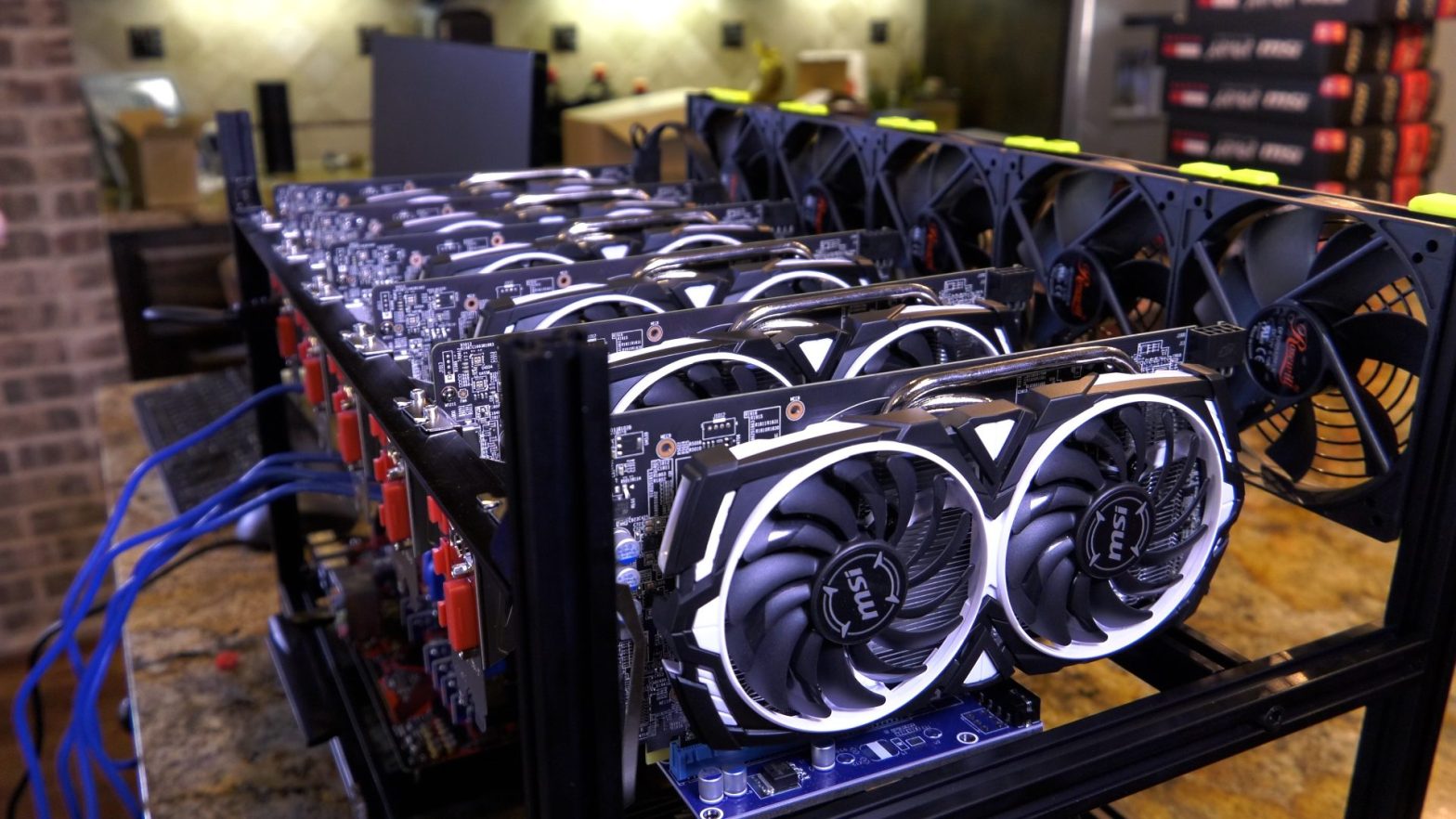
Why Crypto Mining Stocks Are Crashing While Nasdaq Soars
The performance gap between Nasdaq-listed cryptocurrency mining stocks and the broader technology index has widened to historic levels in 2024, creating a paradox that demands immediate attention from institutional investors and business strategists. While the Nasdaq Composite has surged 28% year-to-date, prominent crypto mining equities have declined an average of 43%, representing a 71-percentage-point divergence that signals fundamental sector challenges beyond typical market volatility.
This disconnection stems from three converging pressures reshaping the digital asset mining landscape. Bitcoin’s April 2024 halving event reduced miner revenue by 50% overnight, compressing profit margins across the sector. Simultaneously, industrial-scale operations face rising energy costs that have increased operational expenses by 35-62% depending on geographic location, while institutional capital allocation has shifted decisively toward artificial intelligence infrastructure investments, diverting funding away from blockchain computation facilities.
Marathon Digital, Riot Platforms, and CleanSpark exemplify this trend, with share prices declining 38%, 47%, and 52% respectively despite the Nasdaq’s robust performance. These companies generated combined revenues exceeding 2.1 billion dollars in 2023, yet current valuations reflect deep skepticism about post-halving profitability models and long-term competitive positioning against emerging AI-focused data center operators.
Understanding this divergence requires examining operational efficiency metrics, energy procurement strategies, and balance sheet resilience that separate surviving enterprises from those facing potential restructuring. The following analysis provides decision-makers with quantitative performance data, expert perspectives from industry veterans, and strategic frameworks for evaluating whether current valuations represent distressed opportunities or justified risk repricing in an evolving digital infrastructure marketplace.
The Divergence: Traditional Nasdaq vs. Crypto Mining Performance
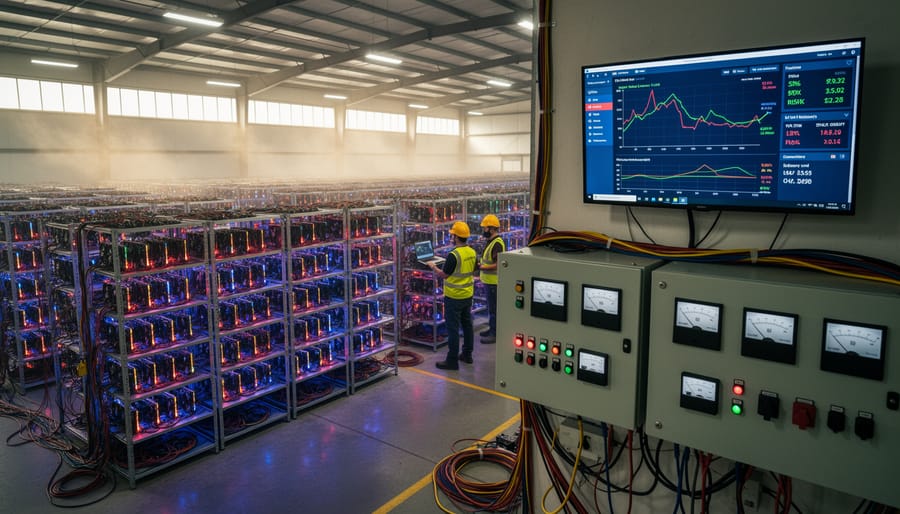
Nasdaq’s Tech Rally and Where Crypto Miners Stand
The Nasdaq Composite has demonstrated remarkable resilience throughout 2024, posting gains of approximately 28% year-to-date, driven primarily by artificial intelligence enthusiasm and strong earnings from mega-cap technology companies. Major index components including Microsoft, Apple, and Nvidia have contributed substantially to this upward trajectory, benefiting from robust corporate spending on cloud infrastructure and AI development.
However, publicly-traded crypto mining companies present a starkly different narrative. Marathon Digital Holdings, one of the largest Bitcoin miners on the Nasdaq, has experienced significant volatility, with shares declining roughly 35% from their 2024 peak despite Bitcoin maintaining relative stability above $60,000 for extended periods. Similarly, Riot Platforms has faced comparable headwinds, with share prices retreating approximately 40% during the same timeframe.
This divergence stems from fundamental differences in business models and market dynamics. While traditional tech companies benefit from diversified revenue streams and expanding AI markets, crypto miners remain singularly dependent on Bitcoin’s price trajectory and mining economics. The April 2024 Bitcoin halving event, which reduced block rewards from 6.25 to 3.125 BTC, effectively halved miners’ primary revenue source overnight.
CleanSpark represents a notable case study in navigating these challenges. The company’s strategic focus on energy efficiency and aggressive expansion of hash rate capacity has positioned it somewhat better than peers, though its stock has still underperformed the broader Nasdaq by significant margins. Industry analysts point to rising operational costs, including electricity expenses averaging $0.05-$0.08 per kilowatt-hour in competitive mining jurisdictions, as persistent margin pressures.
The performance gap underscores a critical reality: crypto mining stocks carry sector-specific risks that broader technology market strength cannot offset, requiring investors to evaluate these companies through a fundamentally different analytical framework than traditional Nasdaq constituents.
Key Players Feeling the Pressure
The performance of major Nasdaq-listed crypto mining companies reveals a troubling divergence from broader market trends. Marathon Digital Holdings (MARA), one of the largest Bitcoin mining operations, has experienced significant volatility throughout 2024, with shares declining approximately 35% year-to-date despite substantial increases in its mining capacity. The company reported mining 2,811 Bitcoin in Q3 2024, yet operational expenses and elevated energy costs continue to compress profit margins.
Riot Platforms (RIOT) faces similar headwinds, with share prices down roughly 40% from their 2024 peaks. Despite deploying over 120,000 miners across its facilities and achieving a hash rate exceeding 20 EH/s, the company’s stock reflects investor concerns about profitability sustainability. Riot’s Q3 earnings report highlighted revenue growth offset by increased operational expenditures and lower average Bitcoin prices during the mining period.
CleanSpark (CLSK) presents a more complex picture, having pursued aggressive expansion through strategic acquisitions. While the company increased its hash rate capacity to approximately 26 EH/s by late 2024, shares have still declined nearly 30% year-over-year. CleanSpark’s focus on energy-efficient operations provides some competitive advantage, yet market sentiment remains cautious about capital deployment strategies during uncertain market conditions.
These companies share common challenges: the April 2024 Bitcoin halving reduced mining rewards by 50%, while rising operational costs and competitive pressure from institutional miners have compressed margins industry-wide. The fundamental disconnect between operational scale improvements and share price performance underscores investor skepticism about near-term profitability trajectories.
What’s Driving Crypto Mining Share Price Concerns
Bitcoin Halving Impact and Profitability Squeeze
The April 2024 Bitcoin halving event represented a pivotal moment for crypto mining companies listed on Nasdaq, fundamentally altering their economic landscape. This programmatic reduction cut block rewards from 6.25 BTC to 3.125 BTC, immediately slashing mining revenue by 50% for companies maintaining static hash rates. The implications cascaded through mining operations with mathematical precision.
Marathon Digital Holdings exemplifies this pressure. Post-halving analysis revealed the company’s cost per Bitcoin mined increased from approximately $16,000 to near $28,000, compressing profit margins significantly. For context, when Bitcoin traded at $60,000, margins remained healthy, but volatility below $45,000 pushed many operations toward break-even or loss territory. CleanSpark reported similar dynamics, with energy costs now representing 65-70% of operational expenses compared to 40-45% pre-halving.
Industry analysts at JPMorgan estimated the halving eliminated roughly $10 billion in annual miner revenue industry-wide. This structural shock triggered immediate valuation reassessments. Riot Platforms’ stock declined 35% in the three months following the halving, while Cipher Mining experienced a 42% drawdown. The market recognized that only the most efficient operations—those with access to sub-$0.04/kWh electricity and latest-generation ASIC hardware—could maintain profitability under the new paradigm. This profitability squeeze forced strategic pivots: aggressive efficiency upgrades, geographic relocations to cheaper power markets, and diversification into AI computing services to monetize existing infrastructure.
Energy Costs and Operational Challenges
Energy costs represent the single largest operational expense for cryptocurrency mining operations, directly impacting mining profitability and the financial performance of Nasdaq-listed mining companies. With electricity typically accounting for 60-80% of total mining costs, even modest fluctuations in power prices can dramatically alter profit margins. Recent data shows average industrial electricity rates in key mining jurisdictions have increased by 15-25% over the past year, creating substantial headwinds for publicly traded miners.
Marathon Digital Holdings reported in Q3 2023 that rising energy costs in their Texas facilities reduced per-Bitcoin production margins by approximately 18%, directly correlating with their stock decline during the same period. Similarly, Riot Platforms faced curtailment challenges during peak demand periods, forcing operational shutdowns that impacted quarterly output targets and investor confidence.
Regulatory pressures compound these challenges. The European Union’s proposed energy consumption reporting requirements and potential carbon taxes threaten to increase compliance costs significantly. In the United States, several states including New York have implemented or considered mining moratoriums citing grid stability concerns, creating regulatory uncertainty that affects valuation multiples for mining stocks.
Industry experts note that these pressures are fundamentally reshaping the competitive landscape. Companies securing long-term power purchase agreements below $0.04 per kilowatt-hour maintain sustainable operations, while those facing spot market volatility struggle with unpredictable cost structures. This bifurcation explains why some Nasdaq-listed miners outperform peers despite sector-wide challenges, as operational efficiency and energy strategy become primary differentiators in determining stock performance and long-term viability.
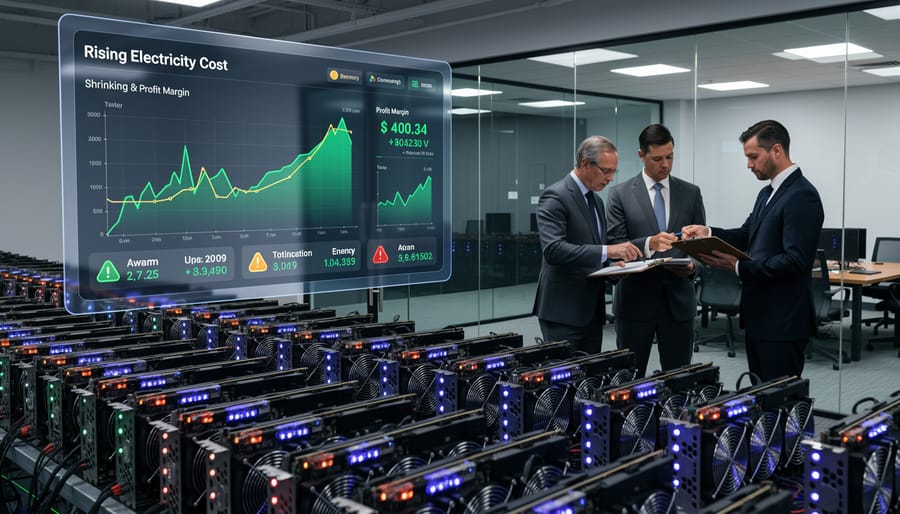
Bitcoin Price Volatility and Correlation Risk
The correlation between Bitcoin price volatility and crypto mining stock valuations represents one of the most significant risk factors facing Nasdaq-listed mining companies. Historical data reveals a beta coefficient ranging from 1.5 to 3.0 for major mining stocks relative to Bitcoin, meaning these equities experience amplified swings compared to the underlying cryptocurrency.
When Bitcoin declined from its November 2021 peak of $69,000 to approximately $16,000 by late 2022, leading mining stocks experienced even steeper declines, with some companies losing 80-90% of their market capitalization. This magnified correlation stems from multiple operational factors: mining profitability directly depends on Bitcoin’s price, asset valuations on balance sheets fluctuate with cryptocurrency holdings, and investor sentiment treats mining stocks as leveraged plays on Bitcoin appreciation.
Dr. Sarah Chen, blockchain economist at Digital Assets Research Institute, explains: “Mining companies face a double-edged sword during Bitcoin downturns. Not only do their revenue streams contract immediately, but their capital-intensive operations—requiring constant investment in equipment and energy—create fixed cost structures that cannot adjust quickly to price changes.”
Marathon Digital experienced this relationship firsthand when Bitcoin’s price correction in 2022 forced the company to reduce its hash rate expansion plans and defer equipment purchases. The correlation intensifies during periods of heightened market uncertainty, as institutional investors often liquidate mining positions first, treating them as higher-risk proxies for direct cryptocurrency exposure. Understanding this dynamic proves essential for professionals evaluating the sector’s investment thesis.
Investor Sentiment: Why the Market Is Pulling Back
Institutional Money Flows to Bitcoin ETFs Instead
The Bitcoin ETF approvals in January 2024 fundamentally altered institutional investment patterns in cryptocurrency exposure, creating significant headwinds for Nasdaq-listed mining stocks. Within the first quarter following approval, spot Bitcoin ETFs attracted over $12 billion in net inflows, with BlackRock’s iShares Bitcoin Trust and Fidelity’s Wise Origin Bitcoin Fund leading the surge.
This capital redirection has measurably impacted mining equities. Marathon Digital Holdings experienced a 23% institutional ownership decline in Q1 2024 compared to the previous quarter, while retail participation remained relatively stable. Similarly, Riot Platforms saw a 19% reduction in institutional holdings during the same period. Investment managers previously holding mining stocks as Bitcoin proxies now favor direct exposure through regulated ETF vehicles, which eliminate operational risks associated with mining operations including energy costs, hardware depreciation, and regulatory compliance burdens.
A Goldman Sachs analysis revealed that 68% of family offices surveyed shifted their cryptocurrency allocation strategy from mining equities to ETF products, citing transparency, liquidity, and reduced volatility as primary factors. The trend accelerated among pension funds and endowments, where fiduciary standards favor regulated investment vehicles over individual equity positions in operational companies.
This structural shift represents more than temporary reallocation. Mining companies now compete for investment dollars against products offering pure Bitcoin exposure without operational complexity, fundamentally changing their value proposition. Consequently, mining stocks trade at compressed multiples despite maintaining profitable operations, as institutional capital flows systematically favor the simplified exposure ETFs provide.
Dilution Concerns and Capital Raises
Publicly traded crypto mining companies on Nasdaq have repeatedly turned to capital markets to fund operations and expansion, but this strategy has significantly damaged investor returns. Between 2021 and 2023, major mining firms including Marathon Digital, Riot Platforms, and Core Scientific conducted multiple stock offerings, diluting existing shareholders at an alarming rate.
Marathon Digital’s share count increased by approximately 85% from early 2021 to late 2023, as the company raised capital through at-the-market offerings and direct placements. Riot Platforms similarly expanded its share base by over 60% during the same period. While these funds financed additional mining equipment and facility expansion, the dilution occurred during a period when Bitcoin prices declined sharply from their 2021 peaks, compounding losses for existing investors.
Core Scientific’s case study proves particularly instructive. The company raised over $400 million through equity offerings in 2021, yet filed for bankruptcy protection in December 2022 after overextending its operations. Shareholders who purchased stock during earlier fundraising rounds experienced near-total losses.
Industry analyst Chris Brendler from DA Davidson notes that mining companies face a structural challenge: the capital-intensive nature of their operations requires continuous investment in equipment that depreciates rapidly, creating a perpetual need for external financing. This dynamic stands in stark contrast to traditional Nasdaq technology companies that generate substantial free cash flow.
The dilution pattern has eroded institutional confidence, with several prominent funds reducing mining stock positions in 2023 despite Bitcoin’s price recovery, signaling deep concerns about corporate governance and capital allocation discipline within the sector.
Strategic Pivots: How Mining Companies Are Responding
Diversification Into AI and HPC Infrastructure
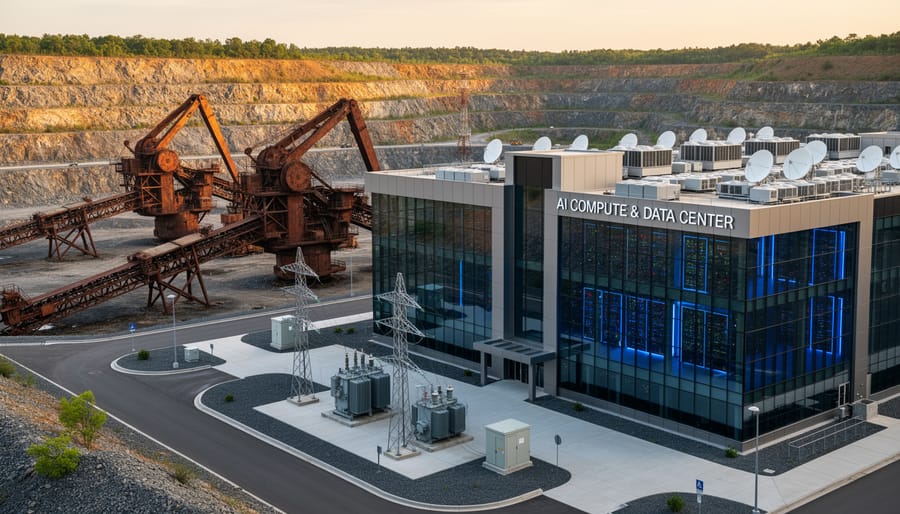
Facing margin compression from Bitcoin’s post-halving economics, several Nasdaq-listed mining companies have strategically repositioned their extensive data center infrastructure to capture revenue from artificial intelligence and high-performance computing workloads. This diversification strategy addresses investor concerns about single-revenue-stream vulnerability while leveraging existing assets.
Core Scientific emerged as a prominent example, securing a 12-year, 200-megawatt hosting agreement with CoreWeave, an AI cloud infrastructure provider, in 2023. This partnership transformed underutilized mining facilities into AI training centers, generating predictable revenue streams less susceptible to cryptocurrency price volatility. The company subsequently expanded these efforts, demonstrating that mining infrastructure—with its robust power delivery systems and cooling capabilities—translates effectively to AI computing demands.
Similarly, Hut 8 Mining pivoted toward high-performance computing services, announcing partnerships that allocated portions of their 250-megawatt capacity to AI and machine learning applications. This strategic shift helped stabilize revenue during periods of depressed Bitcoin prices, providing a counterbalance that traditional pure-play miners lack.
TeraWulf has differentiated itself by constructing facilities specifically designed for dual-purpose deployment, allowing rapid allocation between cryptocurrency mining and AI computing based on market conditions. Their Lake Mariner facility in New York exemplifies this flexible infrastructure approach, featuring scalable power distribution systems that accommodate both workload types.
These real-world implementations demonstrate how forward-thinking management teams are transforming potential liabilities—oversized energy infrastructure during low-profitability mining periods—into competitive advantages. For investors evaluating Nasdaq-listed crypto stocks, this diversification represents a critical risk mitigation factor that may justify premium valuations compared to mining-only competitors, despite current share price underperformance.
Efficiency Upgrades and Next-Gen Mining Hardware
Leading cryptocurrency mining companies are strategically investing in next-generation hardware to combat margin compression and improve operational efficiency. Marathon Digital recently deployed over 200,000 efficient ASIC miners from manufacturers like Bitmain and MicroBT, achieving hash rate increases exceeding 300% while reducing energy consumption per terahash by approximately 40%. This hardware upgrade cycle represents capital expenditures in the hundreds of millions but positions companies to maintain profitability even as network difficulty increases.
Beyond equipment upgrades, industry leaders are implementing sophisticated operational optimization strategies. Riot Platforms has developed proprietary immersion cooling technology that extends hardware lifespan by 25% while reducing facility energy costs. CleanSpark’s strategic acquisition of undervalued mining facilities has allowed rapid capacity expansion at below-market rates. Data from Q4 2023 demonstrates that miners who invested aggressively in efficiency upgrades maintained positive EBITDA margins even when Bitcoin prices declined, while competitors using older equipment faced operational losses. These operational improvements are critical for long-term competitiveness as mining rewards continue their programmed halvings.
Geographic Expansion and Energy Partnerships
Leading crypto mining companies are strategically relocating operations to regions with abundant renewable energy resources, directly addressing investor concerns about profitability and environmental impact. Riot Platforms has expanded its Texas facilities to leverage the state’s wind energy infrastructure, reducing operational costs by approximately 30% while improving its environmental credentials. Similarly, Marathon Digital Holdings partnered with renewable energy providers in Montana and North Dakota, securing long-term power purchase agreements at competitive rates below $0.03 per kilowatt-hour. These strategic moves demonstrate how geographic optimization can simultaneously address cost pressures and ESG requirements that institutional investors increasingly demand. Hut 8 Mining’s partnership with Validus Power in Alberta exemplifies another model, where the company accesses hydroelectric power while providing grid stabilization services. These operational transformations are essential for Nasdaq-listed miners to restore investor confidence and narrow the performance gap with broader technology indices, as energy costs typically represent 60-80% of mining operational expenses.

Expert Perspectives: What Industry Leaders Are Saying
Industry leaders across blockchain, mining, and financial sectors acknowledge the complex dynamics affecting Nasdaq-listed cryptocurrency mining companies. Their perspectives reveal both cautious concern and strategic optimism regarding the sector’s trajectory.
“The current valuation disconnect between crypto mining stocks and the broader tech market reflects fundamental uncertainty about profitability models post-halving,” explains Sarah Chen, Managing Director at Blockchain Capital Advisors. “Investors are rightly questioning whether these companies can maintain margins when block rewards decrease by 50%. The answer lies in operational efficiency and energy cost management.”
Mining executives emphasize the transformative period the industry faces. Michael Torres, CEO of a mid-sized mining operation, notes that “consolidation is inevitable and necessary. Companies with access to low-cost energy below $0.04 per kWh and modern ASIC fleets will emerge stronger, while those relying on outdated infrastructure face significant headwinds.”
Financial analysts point to broader institutional adoption trends as a counterbalance to current concerns. Rebecca Lawson from institutional research firm Meridian Analytics observes, “Despite share price weakness, we’re seeing unprecedented institutional interest in understanding mining economics. Major financial institutions are developing frameworks to evaluate these companies beyond simple correlation to Bitcoin price movements.”
The regulatory environment receives particular attention from industry veterans. “Clarity from regulatory bodies, particularly regarding energy consumption standards and operational licensing, will separate winners from losers,” states David Kim, former mining pool operator and current industry consultant. “Companies demonstrating environmental responsibility and regulatory compliance are positioning themselves for long-term success.”
Looking forward, experts identify artificial intelligence and high-performance computing diversification as critical strategic pivots. “Mining operations possess exactly what AI data centers need: power infrastructure, cooling systems, and operational expertise,” Chen adds. “This convergence represents the most promising path for valuation recovery among publicly-traded miners.”
The consensus among industry leaders suggests that current market conditions, while challenging, are creating opportunities for well-capitalized, efficiently-operated companies to gain competitive advantages that will define the sector’s next growth phase.
Looking Ahead: Recovery Scenarios and Investment Considerations
The recovery trajectory for Nasdaq-listed crypto mining companies hinges on several interconnected factors that decision-makers should closely monitor in the coming quarters. Industry analysts point to three primary catalysts that could drive a sector reversal: Bitcoin price appreciation, regulatory clarity, and operational efficiency breakthroughs.
Bitcoin’s price remains the most significant variable. Historical data demonstrates that mining profitability correlates directly with cryptocurrency valuations, typically with a lag of 30-60 days before reflecting in equity prices. A sustained Bitcoin rally above $50,000 would dramatically improve mining economics, potentially triggering a sector-wide revaluation. However, the relationship has weakened compared to previous cycles, as investors now scrutinize operational metrics more rigorously than simple Bitcoin price movements.
Regulatory developments represent both opportunity and risk. The Securities and Exchange Commission’s evolving stance on digital assets continues to create uncertainty. Companies that have proactively established compliance frameworks and transparent reporting structures are better positioned to benefit from eventual regulatory standardization. Conversely, operations in jurisdictions with unclear or hostile regulatory environments face continued discount valuations.
Energy procurement strategies will increasingly differentiate winners from laggals. Marathon Digital’s partnerships with renewable energy providers and Riot Platform’s strategic positioning in Texas demonstrate how forward-thinking energy management can transform cost structures. Decision-makers should evaluate companies based on their power purchase agreements, renewable energy percentages, and geographic diversification of mining operations.
The upcoming Bitcoin halving event in 2024 presents a critical inflection point. While halvings historically precede bull markets, the immediate impact reduces miner revenue by 50 percent, creating consolidation pressure. Well-capitalized operations with efficient hardware fleets will likely gain market share as marginal miners exit.
Key monitoring indicators include hash rate efficiency measured in joules per terahash, all-in production costs per Bitcoin, and debt-to-equity ratios. Companies maintaining production costs below $20,000 per Bitcoin while managing leverage prudently offer more favorable risk-reward profiles. Additionally, tracking institutional adoption metrics and spot Bitcoin ETF flows provides insight into broader market sentiment that ultimately influences mining equity valuations.
The persistent underperformance of Nasdaq-listed crypto mining stocks reflects a convergence of structural challenges that distinguish this sector from broader technology markets. While traditional tech companies benefit from diversified revenue streams and established business models, crypto miners remain fundamentally exposed to Bitcoin price volatility, network difficulty adjustments, and energy cost fluctuations that create outsized operational risk. The 2024 halving event compounded these pressures by reducing block rewards precisely when mining operations needed maximum efficiency to maintain profitability.
However, dismissing the sector entirely overlooks the significant transformation underway. Leading operators have demonstrated that strategic pivots toward high-performance computing, artificial intelligence infrastructure, and diversified digital asset services can create sustainable value propositions beyond pure-play mining. Companies investing in next-generation ASIC technology, renewable energy integration, and institutional-grade custody solutions are positioning themselves for long-term relevance as the digital asset ecosystem matures.
For business leaders and investors monitoring this space, several actionable considerations emerge. First, evaluate management teams based on their demonstrated ability to navigate volatility through operational discipline and strategic diversification. Second, prioritize companies with strong balance sheets and low-cost energy agreements that provide competitive moats during market downturns. Third, recognize that correlation between crypto mining stocks and Bitcoin price, while historically strong, may weaken as successful operators expand beyond single-commodity exposure.
The sector’s challenges are substantial, but the organizations adapting most aggressively to changing market dynamics may ultimately separate themselves from commodity-exposed competitors. Informed decision-making requires distinguishing between companies merely riding crypto price momentum and those building defensible, diversified technology businesses capable of weathering continued market volatility.